December 18, 2001
The Florida Freshwater Squid
An Overview of History, Habits, and Human Interaction (including such related phenomena as the annual Festival of the Freshwater Squid)
Introduction
In July 1894, during the construction of Standard Oil magnate Henry Flagler’s East Coast Railway, railroad workers discovered the remains of several small “silver and green octopi with ten arms” stranded in the shallow pools left behind by dynamiting, draining, and other invasive earth-moving procedures. Perplexed, the workers brought the “octopi” to their foreman. The foreman showed them to the chief engineer, who, on the advice of his wife, sent the specimens, already rapidly decaying, to marine biologist Gerald Sanders at the University of Florida. Sanders examined them, consulted his reference books, classified the creature as the squid Fons floridanius (later changed to Fons volatilis), and promptly turned his attentions back to his first love, the Florida scrub jay (Aphelocoma coerulescens) (1) Given that even Seminole Indian records and accounts by early naturalists do not mention the squid, the 1894 Flagler1 railroad specimens constitute the first sightings of what would come to be known as the “Florida freshwater squid” or the “mayfly squid.”2
Since this first sighting, the mayfly squid has remained something of a mystery outside of the specialized field of cephalopod studies, despite the occasional mention on television shows like the Discovery Channel’s Everglades: Florida’s Final Frontier (original airing June 15, 2000). Unlike such exotic fauna as the black acara fish (Chiclasoma biaculatum), the Cuban tree frog (Hyla septentrionalis), and, more recently, the nutria (Myocaster coypu), the mayfly squid has settled into its Florida environment with ease. Because it does not displace native species, form parasitic relationships, or cause damage to crops, the mayfly squid has never appeared on a Florida Department of Agriculture and Consumer Services pest report. A study conducted by the Florida Department of Environmental Protection in 1985 concluded, in a typically laconic statement, that “the mayfly squid neither requires protection nor containment.” (2) The lack of good general information has been compounded by inaccuracies published in Florida travel guides. Two recent mentions of Sebring’s Festival of the Freshwater Squid, for example, describe it as “a celebration of squid worldwide” (3) and “a parade centered around the annual boating competition.” (4)
The purpose of the following overview is to provide non-cephalopod biologists and curious laypersons with an introduction to the mayfly squid that centers the squid within Florida’s rich naturalist tradition.3 This will include an examination of claims made by earlier experts, general information on squid’s physiology and habits, and my admittedly subjective assessment of the Festival.
By design, the seasoned cephalopod researcher will probably not find much of interest in this overview. I would refer such specialists to recent monographs by Mark Roberts, Garry Nurrish, and Vanessa Miller, published in the excellent journal Mollusca (Academic Press). For further general information, I refer all readers to the Cephalopod Base and the International Directory of Cephalopod Workers.
Early Naturalists’ Observations of the Mayfly Squid
Edith Johnson: A Pioneer in Mayfly Squid Studies
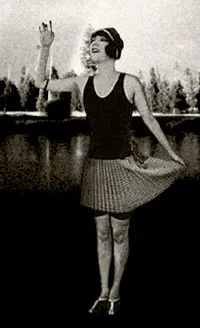
The foremost early naturalist to study the mayfly squid was Edith Johnson (1876-1937), a protégé of the great Florida ecologist John Kunkel Small (1869-1938). In the early 1900s, while still a graduate student at Florida State University, Johnson made her initial reputation by publishing a dozen monographs on the mating and flower selection habits of the ruby-throated hummingbird. (5)
Johnson might have continued to study hummingbirds for many years, if not for an expedition to Lake Okeechobee in May of 1915, during which she observed tell-tale “flashes of green.” (6) Upon further investigation, Johnson was able to document the aftermath of a squid mating frenzy. Intrigued, Johnson decided to take a brief sabbatical from ornithological studies to study the squid. Her sabbatical would eventually turn into ten uninterrupted years of squid research.4
What attracted Johnson to the mayfly squid? Biologist Henry Crawford, Johnson’s contemporary, believed she had intuited superficial similarities between the squid and her hummingbirds: both have high metabolic rates, short life spans, and delicate bodies. Both are highly maneuverable creatures built for sudden, extreme changes of direction. As Crawford remarked in 1923, “Dr. Johnson must have thought she was just changing environments, water for air, rather than making a radical leap.” (7)
Unfortunately, this change in environments led Johnson astray. Modern readers of her two books on the mayfly squid, The Strange World of the Freshwater Squid (1920) and Mysteries of the Freshwater Squid Revealed (1923), quickly become exasperated by the lack of specific detail and, more importantly, her blindness to the subject of silt.
Silt would form the main stumbling block to acceptance of Johnson’s theories because she had chosen to base her research on a stretch of the Ichnetucknee River that had become the most polluted in Florida, primarily due to run off from nearby paper mills. (8) A 1920 U.S. Army Corps of Engineers study, for example, showed a 300% increase in the Ichnetucknee’s silt level between 1916 and 1918. (9) The added silt made the river murky and slow-moving. Yet Johnson claimed to have “observed the squid in the water at some length while wearing snorkeling equipment,” a claim that is difficult to take seriously. (10) Any swimmer in those waters, in addition to imbibing possible carcinogens, would have been unable to see well enough to document the more than one hundred complex mating rituals, color fluctuations, and feeding habits set out in Johnson’s books.
Some experts believe that photographs from the period showing Johnson in an old fashioned bathing suit also undermine her claims. The cut and design of this suit, combined with the pale quality of Johnson’s skin, would have made her similar in outline and color patterns to a large predator fish of the Toxicana family, thus increasing the likelihood of squid flight upon her approach. (11)
In later years, Johnson explained that most of her results were obtained in a laboratory setting, but by then rumors of a life-long drug addiction had tarnished her reputation beyond repair. (12) 5 More importantly, the mayfly squid makes a poor laboratory subject; it refuses to eat and dies within a few weeks.
With the exception of her monographs on the squid’s life span, in which she coined the term “mayfly squid,” Johnson’s work is today considered primarily of historical importance. However, much to the irritation of many naturalists, the Florida Department of Education persists in renewing approval for a high school textbook called Fundamentals of Biology. This book uses quotes and excerpts from Johnson’s work to blatantly impart erroneous information on the life cycle of the freshwater squid.
Gregory and Rebecca Chapman: Advances in Observational Technology
More successful were the efforts of Gregory Chapman (1903-46) and Rebecca Chapman (1901-1962). One of the earliest husband-wife naturalist “teams”-both obtained their advanced degrees from Brown University-the Chapmans developed the world’s first “underwater blind.”
Tested along the banks of the St. Johns River in 1934, the Chapman Blind was modeled after the common bird blind. Made of glass and sunk into the hollowed-out bottom of a houseboat, the blind allowed 360-degree observation of the river bed. Reeds and other aquatic plants were nailed onto the hull of the houseboat for camouflage and green tinted glass masked movement inside the boat.6 To avoid drifting with the current, the Chapmans preferred narrow stretches of river where they could not only anchor the boat but also secure it to trees using long ropes. (13)
Over a period of weeks, the Chapmans moved their blind from location to location with no success. Then, finally, on May 4, 1935, near the St. John’s southern extreme, just before it becomes Lake George, a pair of mayfly squid appeared in the middle distance, visible through the murk as “emerald-silver capsules of light.” According to the Chapmans’ journal, these squid “soon approached the glass of the blind and hovered there, as if trying to figure out what it was, or perhaps entranced by their own reflections. Their bodies soon changed color-from silver to red to blue to green. After a minute or two, they disappeared, seeming to flicker out of existence.” (14)
Funded intermittently by developers,7 the Chapmans made valuable contributions to the mayfly squid research, especially in the area of “flash communications.” World War II cut the Chapmans’ studies short and sent Gregory to his death. Shortly thereafter, a belligerent 16-foot St. John’s alligator, known by the locals as “Big Jack,” destroyed the Chapman blind. (With typical calm, Rebecca Chapman recorded the precise details of the alligator attack in her journal.)
Today, outside of the insular world of cephalopod studies, the Chapmans are perhaps best known for the photograph that hangs in the old Capitol Building in Tallahassee. It shows them shaking hands with Frederick Preston Cone, Florida’s 27th governor, in front of their beloved squid blind.
Leonard Smythe: Inadvertent Findings
Ironically, an amateur scientist named Leonard Smythe made the most important early discovery about the mayfly squid. For years, based on the lingering influence of Johnson’s books and the difficulty of accurate field studies, cephalopod experts had assumed that the adult female freshwater squid gave birth to a few fully-formed juveniles three or four times a year.
Smythe, a traveling salesman from Palatka, Florida, disproved this theory using a bucket and an aquarium. An avid fish enthusiast and a member of the local chapter of the Freshwater Fish Association, Smythe liked to fill buckets with Palatka River water and strain out any likely-looking food for his fish. One day in May of 1944, Smythe caught a “cluster of what looked like tiny insect larvae, each with a hook on their end.” That afternoon he fed the “larvae” to his neon tetras, guppies, and angelfish, left further feedings to his sister, and set off on a ten-day circular sales trip through the small towns of north-central Florida.
Upon his return, Smythe found most of his fish eaten and the remainder in a tense stand-off with a “half-dozen graceful, jelly-like creatures with luminous eyes.” Smythe quickly consulted his Field Guide to Aquatic Life of the Southeastern United States, but the 1947 edition did not contain any mention of the mayfly squid-or anything that looked remotely like his intruders. It took a telephone call to Dr. Sarah Willis at the University of Texas’ National Cephalopod Institute (Galveston, Texas) three days later before he understood what sort of creature had magically appeared in his tank. (15)
Although Smythe subsequently passed out of history, eventually retiring to run a Palatka bait shop, his contribution proved perhaps more enduring than Dr. Johnson’s ten years of studies.8
An Overview of the Mayfly Squid’s History, Physiology, and Habits
The Mayfly Squid’s Introduction into the United States
Origins
The most plausible theory for how the mayfly squid reached Florida’s lakes and rivers speculates that juvenile “lula brasileira de água fresca” or Brazilian freshwater squid (Fons brasiliensis)9 arrived in Miami or Tampa via ships of South American Registry. Since Brazilian freighters have docked at South Florida ports since the 1870s,10 it is not improbable that squid young could have made the journey to the United States in water that collected in cargo boxes, a sailor’s shoes, or even a half-closed umbrella. (16)
An alternate theory relies on known cases of travelers purposefully bringing foreign species into the United States.11 If this is the case, then the mayfly squid may have entered the Florida ecosystem when someone grew bored with their exotic acquisition and dumped a tank of adult and/or juvenile squid into a lake or stream.
Regardless of the entry method, a connection does seem to exist between the Brazilian and Floridian squid. Yale University’s Charles Sibly studies the biochemical binding possible between the DNA of different species. The more two species bind at the DNA level, the closer the relationship between them. In the case of the Brazilian and Floridian freshwater squid, Sibly reported a 94% match-proof of a connection between Fons brasiliensis and Fons volatilis, but not conclusive enough for Fons volatilis to be reclassified as Fons brasiliensis volatilis. (17)
Dispersal
Once the mayfly squid became established in the Florida ecosystem, the state’s natural weather patterns conspired with the juvenile squid’s natural hardiness to facilitate range expansion. Sandra Westwood’s 1989 study “The Response of Mayfly Squid Juveniles to Adverse Conditions” demonstrates that the squid larvae can survive for weeks surrounded by only a thin protective bubble of water. In such circumstances, the squid’s normal growth cycle slows or halts altogether until a larger water source impacts upon it. (18)
The squid’s reproductive cycle results in fertilization of the female sometime between May and July, followed by the birth of the young squid six weeks later. This cycle coincides with Florida’s May-to-September hurricane season. As a result, flooding due to heavy rains has helped spread the mayfly squid from south to north Florida and beyond.12
Another dispersal method facilitated by heavy rains provides further circumstantial evidence for the Brazil-Florida link and also explains the temporary hook found on the juvenile’s mantle.
The Brazilian freshwater squid will, whenever possible, enter into a symbiotic relationship with the Giant Amazonian catfish (Pteronura brasiliensis) by giving birth in their vicinity.13 The catfish will eat some of the young squid, but the majority use their hooks to find safety on the sides of the catfish. Over the next four to six weeks, they will scrounge scraps left over from the catfish’s own scavenging and reward its host by eating any parasites that settle on the catfish’s skin. (19)
How does this relate to mayfly squid range expansion? In 1949, a mating pair of walking catfish (Clarias batrachus) escaped from a Broward County fish farm. The fish quickly spread throughout South Florida. After periods of heavy rain, the catfish lives up to its name by “using its pectoral fins as crutches, wriggling its tail like a propeller” to move from pond to pond. (20) In 1956, Raymond Trainer, a professor of ecology at the University of Miami, noticed that many of the walking catfish he tagged after thunderstorms had masses of insect larvae clinging to their sides. Further investigation revealed that these “insect larvae” were actually mayfly squid juveniles. (21) In a remarkable instance of instinctive adaptation to a new environment, the female mayfly squid had recognized a variation on an old theme and proceeded to take advantage of the situation. As an unexpected consequence, the walking catfish has provided the mayfly squid with another way to populate squidless areas of the state.14
Distinctive Physical Attributes
In General
Like most squid-from such shallow water species as Sepia loligo (the Swedish barking squid) to such deep water varieties as the ominous-sounding Vampyroteuthis infernalis (the vampire squid) — the mayfly squid has eight arms and two tentacles. The tentacles are longer than the arms and covered in a series of hooks designed to help bring prey to its mouth. The body consists of a mantle and a head. The mouth hides the beak, which is usually small in relation to the body and the hardest part of the squid. Its gills extract oxygen from water. Two hearts pump more blood into its brain each day than a human brain receives in a week. The squid moves using a propulsion system centered around the ejection of water from its funnel, a short, hose-like organ located on the mantle. Often referred to as a “super mollusk,” squid fall into the following classifications: Animalia (Kingdom), Mollusca (Phylum), Cephalopoda (Class), Coleoidea (Subclass), Decabrachia (Super order), Teuthida (Order), and Myopsina and Oegopsina (Sub-orders), with the mayfly squid categorized under the family Loliginidae and the genus Fons.
The average adult mayfly squid weighs about 18 ounces and, including tentacles, is about two inches long. There are no obvious differences between the male and female mayfly squid, but the female may be slightly larger than the male. That the gills process freshwater rather than saltwater is unusual but not unprecedented in the cephalopod world.
The Eyes
The rarest feature of the mayfly squid is its eyes. Like the Brazilian freshwater squid and only two other species, the mayfly squid has three eyes, the third eye hidden on the underside of the mantle. The two eyes on either side of its head are non-binocular-and therefore superior to human eyes, although they probably do not see color-but small and not as receptive to light as those of most other squid species. Given the mayfly squid’s probable origin in the Amazon, a river almost as silty as the Ganges, this is not surprising.
However, certain photophore arrangements and retina alterations of the third eye do startle even the seasoned researcher, for these arrangements and alterations suggest that the third eye produces a beam of light that aids the squid in seeing through water that has a high silt content. (23) Of even greater interest is the strange mass of nerves connected to the third eye that reminds some researchers of similar nodules found in the Amazon river dolphin (Inia geoffrensis). This almost blind cetacean navigates through the muddy river by eco-location alone. Does the mayfly squid also use a form of eco-location? No studies on this subject have as yet been completed, in part because the quick response time of squid to stimuli makes it difficult to establish controls for such experiments. (21)
Color Fluctuations
Depending on conditions such as temperature and background, the mayfly squid will manifest itself in a dull silver or in a shimmer of faint green. When startled, mating, or stalking prey, the squid displays a wide spectrum of colors and patterns across its skin. As William Blake once wrote of another type of squid entirely, the skin “flames and gutters with its own potency.” (25)
The mayfly squid’s ultra-sophisticated control over its coloration and patterns might seem inexplicable given the often limited visibility available to it. However, if the mayfly squid’s third eye does detect bioluminescence, then the evolutionary advantage of such control becomes apparent: even in the high silt conditions of the Amazon (or some of Florida’s more polluted rivers), it can remain in communication with other squid, using what amounts to a form of cryptography.
Prey
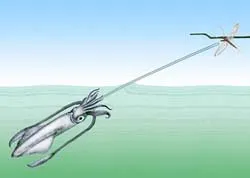
Although all squid use their tentacles to bring prey within reach of their mouths, they feed in a variety of different ways. Some squid swallow their food and others batter it against underwater rocks to tenderize it. Still other squid, like the mayfly squid, chop up and grind down their food using beak, teeth, and pistolaro (a tongue-like organ).
Mayfly squid will eat anything, including other mayfly squid. Specific prey animals include fish, small birds, crayfish, crabs, small turtles, new-born alligators, and insects. As captured on videotape for the Discovery Channel’s Everglades special, the mayfly squid will sometimes shoot water at insects on overhanging tree branches.(26) The aim of the mayfly squid is surprisingly accurate and even a large beetle will be knocked into the water after two or three tries. Incidences of scavenging from humans are rare.15
Predators
The mayfly squid’s Brazilian equivalent must be wary of birds, catfish, otters, crocodiles, dozens of different types of fish, and giant turtles. Florida alligators and snapping turtles, by contrast, do not appear to like the taste of squid flesh unless other food sources are scarce. Birds constitute a greater threat, but the mayfly squid is usually too quick for great blue herons, ospreys, and anhingas. Smaller birds cannot handle an adult mayfly squid, while avian juveniles, such as ducklings, may find themselves eaten by the squid. Almost all fish love to eat juvenile squid, but few species eat the adult version. Park rangers stationed at Paynes Prairie (Gainesville, Florida) claim to have witnessed otters eating freshwater squid, but this has not been verified by naturalists in the area. And, since the closing down of the Okeechobee squid mills (see Florida Squid Mills, below), humans have ceased to be anything but a secondary threat, through habitat destruction and pollution.
When mayfly squid do find themselves under hostile scrutiny, they use a number of nasty defense mechanisms to discourage these perceived threats (as I can attest to from first-hand experience). The most common consists of lightning-quick color changes designed to interrupt the predator’s normal attack sequence; however, it will continue to change color even while employing its other, escalating, strategies.
If flight is at first impossible, the squid will darken the waters with its green ink and then attempt to flee. Should a predator persist, the squid will eject a cloud of poisonous bacteria from its plocium pouch (located next to the stomach).
Should all of these tactics fail, the mayfly squid will attempt to suffocate its attacker by stuffing its arms and tentacles into any available orifice.16 A final (and fatal) defense mechanism-literally turning itself inside out-is only used to distract a predator from a group of squid.
Mating Rituals
Mating rituals, as distinguished from the mating cycle,17 constitute my specific area of mayfly squid expertise. Ever since my graduate student days at the University of Florida, I have been fascinated by the mayfly squid’s creativity at courting.
The male squid initiates the mating rituals two or three days before coitus takes place. On the first day, the male squid anchors itself amid the dead leaves and aquatic plants on the lake or river bed. (If, as is often the case, many squid live in close proximity, the male squid may place themselves within a few feet of each other.) Once firmly secured to the bottom, the squid uses its pistolaro and beak to secrete a series of clear bubbles (approximately six centimeters in diameter) that it then gently sticks to its skin using its tentacles. After covering its mantle, head, and arms, the squid will hide its tentacles beneath whatever debris is handy, leaving only its eyes free of bubbles.
The male squid then puts on a kind of light show to attract the female, skillfully manipulating its colors and patterns to shine refracted bioluminescence through the bubbles. From a distance, a bubbled male squid resembles an exotic gemstone with a thousand perfectly cut facets.
Within 24 hours of the male constructing its “bubble tent,” a female squid will appear, circling in the water over the male for several minutes before either investigating further or swimming off into the distance. (At any stage of the mating rituals, up to and including coitus, the female may break off the engagement and swim away.) If the female investigates further, she will first hover directly over the male and then gently rub off the bubbles on its mantle and head. As soon as she does so, the male squid’s light show ends and he begins to pulse a deep, rich green. The female, silver rippling up and down her body, then presses up against the male’s mantle and head, wriggling the fins of her mantle as if to tickle the male squid. Less than a minute later, she places her arms and tentacles over the arms and tentacles of the male.18 They both change color to pure silver. This color change concludes the first phase of the mating ritual.
The second phase begins when the male’s colors fluctuate wildly, from green to silver to purple. This is the female squid’s signal to allow herself to be chased by the male, sometimes for as long as 12 hours. During this period, she will perform a series of maneuvers intended to emphasize her agility, speed, and endurance. At irregular intervals, she will turn on the male squid and chase him instead, before once again allowing him to chase her. Whether this intricate “fatigue dance,” with its stops and starts, its sudden changes of direction, and its bursts of speed, ever leads to death for either party prior to mating is unknown. Regardless, in some respects the dance signifies a last celebration of strengths that both will soon lose, the male before the female.
On the third day, entwined in each other’s arms and tentacles, the mating pair ascends to the surface of the lake or river, there to mate and produce the fertilized eggs that the female will care for until they hatch, some six weeks later. The resulting cloud of young will grow at an exponential rate and reach maturity in one month. Nine months later, they will repeat the mating rituals of their parents.(27)
Human Interaction with the Mayfly Squid
Florida’s Squid Mills
A Risky Scheme
In 1948, the brothers Jeremy and Henry Davids stole a page from the already booming Florida fish farms19 and built the first squid mills on the banks of Lake Okeechobee. Like many Florida entrepreneurs before and since (see: Ralph Parker and his ostrich farms), the Davids believed that an exotic animal could be turned into a profitable replacement for more traditional meats. The enterprise was funded with money from their inheritance; their father Bill Davids, recently deceased, had been a real estate developer and politician.20
The Davids’ risky scheme called for construction of squid mills and a cannery without first testing a squid mill prototype or acquiring a nationwide distributor.21 For the squid mill design, they secured the services of the inventor Arthur T. Lynch. Lynch had previously obtained patents for an automated dog kennel, a self-cleaning cat carrier, and several other animal-confinement devices. Wealthy retirees in West Palm Beach had bought his more domestic inventions by the score. As he wrote in a May 1948 letter to the Davids brothers, “it is time to work my magic on a more commercial scale.” (28)
Lynch eventually delivered a contraption on pontoons that combined elements of a lobster trap with his earlier inventions. Made of wire mesh, the squid mill’s several compartments could be lowered by a winch until they touched bottom and closed off a portion of the lake. Lures popular in squid jigging (along with live bait) would be placed on the inner “gate” of the squid mill, with access controlled through a series of latches. The latches would pose no problem for “wild” mayfly squid to open, but would be alligator-, fish-, and turtle-proof . Once inside, the wild squid would eventually find their way to the central pen that housed the domesticated squid, adding to the potential meat harvest. Several squid mills could be set side by side, or they could be placed at a distance from each other. The center pens could be subdivided or enlarged as necessary. In anticipation of the mating season, Lynch designed a series of grooves on the sides, top, and bottom of the pens. Wooden slates that slid into the grooves would imprison the juvenile squid, which would otherwise have swum to freedom through the holes in the mesh. Further innovations allowed the Davids to separate the female and male squid immediately after mating-the males for slaughter, the females to a “nursery” area.22
Success and Failure
The Davids approved of Lynch’s invention and ordered 30 units. They then hired men with fish farm experience and set up operations on the south shore of Lake Okeechobee. By the summer of 1949, the first canned squid were rolling off the assembly line and into grocery stores across Florida. A distribution contract with the Publix Supermarkets chain23 helped fund an advertising campaign in a few Florida newspapers. One ad in the St. Petersburg Times showed a classic clip-art 50s dad sharing a can of squid with his son over the tag line “Davids Bros. Canned Freshwater Squid: As Pure As the Best Things in Life. Buy Some at Your Local Grocer’s Today!” Third-quarter sales of canned squid netted the Davids brothers $10,000 in profits. (29)
Based on this success, Henry Davids wrote to his mother-in-law in November 1949 that “It’s official-they can’t keep our product on the shelf! We’ll be rich in under a year.” (30) Unfortunately, due to certain limitations of the mayfly squid, success was even then slipping away from the Davids brothers.
First, the squid did not do well in captivity, even though the pens were immersed in the lake. The Davids’ domesticated squid stock suffered a 60% mortality rate in the initial nine months, which not only cut into the amount of product-many of the carcasses rotted before they could be retrieved from the bottom of the maze-like squid mills24-but also reduced the breeding stock. The Davids brothers made up the difference early on by jigging large numbers of wild squid, but the temporary boost in meat quantity did nothing to help the decimated breeding stock.
Second, mayfly squid do not taste as good as other types of squid. In the interests of research, I have eaten over 20 different species of squid. Although edible, the mayfly squid is at the rubbery end of the spectrum, and tasteless. The Davids had reduced the rubbery quality by immersion in salt and dealt with the taste issue by adding cheap watered-down soy sauce. Even so, the novelty had worn off and, by the end of 1950, David Bros. Canned Freshwater Squid, the “Distinctly Florida Treat,” no longer leapt off the shelves and into consumers’ shopping carts. (31) 25
To compound the brothers’ problems, Publix failed to renew its contract at the beginning of 1951. By July of 1951, desperate for revenue, the Davids set up a tour of the mills-the first time anyone had attempted to use the mayfly squid to attract tourists. However, records show that the Davids brothers only sold 500 tickets between July 1951 and July 1953.
By January of 1953, the squid mills served merely as holding tanks for wild squid. The cannery worked at one-twelfth capacity and all but 9 of the original 35 employees had been laid off.
The Davids took out a loan in August of 1953 to buy large quantities of squid directly from the West Coast and Japan, only to find most of the meat in rotted condition upon its arrival. The brothers hung on for the rest of the year, but in early 1954 Henry Davids left the business, signing over his half of the company to his brother. Jeremy continued on for 18 months, despite mounting debts, but in 1956 sold the business to a local developer and moved to Cincinnati, Ohio, to work as a clerk in his father-in-law’s bank. (Henry met much the same end, working as an actuary in Chicago, Illinois, for several decades.)
The Fate of the Squid Mills
Arthur T. Lynch’s abandoned squid mills survived for another 20 years. As late as 1975, birders walking along the shore of Lake Okeechobee could inspect the pontoons and rusted wire cages. In 1976, tropical storm Ada dislodged the squid mills from the shore and for more than a decade they floated around the lake, a source of irritation for fishermen and other locals. Finally, in 1988, county officials had the squid mills removed from the lake as a public nuisance. By this time, the mayfly squid had spread throughout the state and Lake Okeechobee no longer served as one of its primary breeding grounds. (32)
The Festival of the Freshwater Squid26
Early Risers
Every second weekend in May, the mayor and other municipal officials of Sebring, Florida, rise well before dawn to kick off the annual Festival of the Freshwater Squid. On the steps of the Old Town Hall, the mayor addresses a crowd that has, in recent years, risen to more than 20,000 (5,000 of the 15,000 local residents and 15,000 tourists). (33) The hotels have been booked for months and the town has been preparing for the influx of Festival-goers on-and-off since the end of the last festival. Swarms of sterile mosquitoes released as an experiment by the University of South Florida fill the cool pre-dawn air, but people don’t seem to mind-they’re excited about observing another of the state’s exotic species, the mayfly squid.
After a short speech, the mayor, Scott Thomas, cuts the green-and-silver ribbons held across the parade route by two cheerleaders from nearby Highlands High School. The mayor’s brother, town sheriff Jeffrey Thomas, signals for the first parade floats to glide into position. As night begins to give way to dawn, many people surge ahead of the parade, eager to be the first to the boats that will take them to the middle of Lake Jackson and the freshwater squid’s traditional mating grounds.
Origins of the Festival
Sebring, Florida, is perhaps the perfect setting for a freshwater squid festival. Situated amid 15 kilometers of lakes that lie along the south end of the Lake Wales Ridge, Sebring is a popular location for water sports and boat trips. (34) 27 Although Lake Jackson, Sebring’s largest lake, does not contain Florida’s highest concentration of mayfly squid, it is the most accessible of the squid’s breeding grounds. (Mayfly squid are more plentiful in the boggy cypress habitat of the northern Wacissa River, but the area is off-limits to all boats except canoes.)
Sebring needs a Festival in the summer as well, since the town is otherwise moribund until the autumn racing season brings the Grand Prix Raceway alive for the American Le Mans Series.28 In May, Panacea’s Blue Crab Festival and Fernandina Beach’s Isle of Eight Flags Shrimp Festival are the only competition. The event closest in spirit to the Festival of the Freshwater Squid, the Sea Turtle Watch held in Jensen Beach on the Atlantic coast, does not occur until June. (35)
The Festival began 12 years ago as the brainchild of local writer Jan Hines, a 46-year-old print shop manager who at first “just saw it as a good excuse for a summer party, and to sell some of my books. I never thought the town would actually sponsor it. And I never thought we’d ever see thousands of people coming down here for it.”29
The books, self-published through Hines’ print shop, are very popular at the Festival. They relate the adventures of a talking squid named Hellatose. “They’re for children and adults,” Hines says. “Children like the plots and pictures. Adults like the subtext. It’s all in good fun.”
As for the thousands of tourists, most of them are from in-state, brought by word-of-mouth, newspaper articles, and the guidebooks. A few, like a German family I met on the parade route-sweaty and pink and slightly dazed from all the noise and color-come out of curiosity. “We were on vacation in Orlando,” the father told me, “and wanted to see part of the real Florida.” They seem satisfied that they have.
The Parade
Despite the fact that the mayfly squid is neither endangered nor particularly edible, an entire subculture, largely unknown to the outside world and adhering to its own set of rituals, has grown up around this small invertebrate.
The parade represents the first of these rituals, a preliminary event that most locals participate in even if they don’t take to the water later. It constitutes a uniquely Floridian oxymoron of sincerity and tackiness, part of a town that, by virtue of its strip malls, old abandoned Art Deco hotels from Sebring’s boom period of the 1950s, and falsely-antique historic district, epitomizes the Florida impulse to meld pristine landscapes with facades of authentic human habitation.
The parade winds its way through the three blocks of quaint white-washed wooden houses that comprise the Historic District, past such institutions as the Inn on the Lakes, and then onto Sebring’s main drag, Roosevelt Boulevard. The path is lined with crepe paper lanterns in the mayfly squid’s most common strobing colors: vibrant shades of purple, green, and silver. The candles inside the lanterns make the crepe paper shimmer with light. The usual cavalcade of Shriners in tiny red cars, high school bands, ROTC units, and clowns is supplemented by six or seven squid floats mounted on rusting Ford pickup trucks. Most of the floats are made of crepe paper as well, although a couple have been painstakingly woven together from honeysuckle and green ivy, the pungent scent of the flowers taking the edge off the ever-present marsh smell from Lake Jackson.
Meanwhile, the parade-goers have begun to don their squid masks and take out their squid noise-makers. Any chance the high school bands had of impressing the tourists is soon lost in the clacking and croaking of the noise makers. Small boys always feel the need to set off caps and the resulting gunpowder smell gives the scene a slightly anarchic flavor. As I follow the festival crowds, the fake squid formed by the floats seem to waver and disintegrate in the early morning light.
The Mating Grounds
Eventually, packed tightly together, the crowds lurch within sight of Lake Jackson. The floats, bands, and other parade participants march off into a side alley while we tourists head for the water. The near side of the lake teems with waiting boats. Most of the vessels have been chartered weeks in advance and I hear a few unlucky tourists asking if anyone has a seat available. (All lake traffic, whether rusted fishing boat or two-deck yacht, must adhere to the city council mandated speed of 5 MPH, “so as to facilitate,” according to Sebring City Ordinance 93-0053A, “an atmosphere conducive to the squid’s habits while also reducing the possibility of boating accidents.”)
Among the lines of tourists are a few observers like myself: trained cephalopod biologists eager to record what we can of the mayfly squid’s mating habits, even in such congested conditions.
However, some local biologists do not think much of the Festival, considering it a hazard to the squid. George Grayson, a marine ecologist who has worked for the State’s Department of Environmental Protection for 20 years, told me that the Festival “disturbs the mating cycle. It also disturbs the ecosystem. Most of the tourists are pretty indifferent about tossing their trash in the water. Every year, the town has to hire people to clean up afterwards.”
Nevertheless, after we get on board and the boats begin to move slowly forward toward the center of the lake, everyone quiets down. When the tell-tale silver-green glow begins to cut through the nascent sunlight, it is clear that the squid have once again congregated in great numbers. (Grayson estimates the lake contains more than 2,000 squid.) Excitement gives way to a kind of anticipatory awe. I look around and find that the squid have everyone’s full attention, even the kids. The old man to my right takes off his baseball cap and shoves it into the pocket of his Bermuda shorts. A college student stops writing in her journal.
Then the engines cut off and the silence really encroaches on us, the only sound a quiet ripple of waves against the prow. Everyone gathers along the railing, staring down into the water. They’re looking for the squid and, out here in the center of the lake, with the silt and hydrilla almost completely absent, you can really see into the water.
For a moment, though, I don’t see anything in the water. Then, a boy reaches out between the railing bars and points at something. Everyone leans in the direction of that pointing finger-and there they are, the squid, in numbers, sleek and small and incredibly fast, looking for all the world like Edith Johnson’s hummingbirds retrofitted for the water. They pulse with an emerald light that ripples up and down their silvery bodies. Despite the fact I’ve seen them up close and at a distance, in the wild and in the laboratory, so many times, my breath catches in my throat.
Still no one says anything. I have the feeling I’m not the only one holding my breath. The quick scooting and sliding through the water of these squid, their third eye blinking on and off on the underside of their mantels, at first seems random, chaotic, without purpose… but on second and third glances, I can tell that they’ve already entered the end stages of a complex series of maneuvers that should end in a successful mating. Dozens of squid riddle the water beneath us, and yet, through an ingenious recognition mechanism, no mating pair becomes separated in the process.
This intense level of activity continues for about an hour, until the sun has completely risen, casting a glow on the water that hampers visibility. Then the moment I have been waiting for, the moment I’m not sure my fellow watchers expected, occurs: the activity ceases all across the lake and each mating pair in the water below us lies perfectly still, the male atop the female, the tiny eyes of each seemingly turned up to watch us. With the flashing of colors abruptly ended, the water is dull with our own reflected faces. Several minutes pass. No one speaks. No one moves. Then, all at once, the lake erupts with streaks of emerald-a deep, bright green that suffuses the sides of the white-hulled boats. A gasp rises up all around me. This synchronization of mating and color display may be one of the most beautiful yet mysterious events in the natural world. Despite 20 years of study, no one, from cephalopod experts at Harvard to researchers in the Everglades, has been able to pinpoint the exact how’s and why’s of this phenomenon.
After a few minutes, the display subsides, the squid disappear into the depths of the lake, and everyone begins chattering happily, as if to confirm that it really happened by replaying it again and again in words.
The unhappy epilogue to the event, which most of my companions on the boat probably do not realize, is that almost immediately after mating the male squid will die of fatigue and old age. The female will survive only long enough to ensure the successful birth of her young. The mayfly squid does, in fact, live up to its namesake.30
Distinctly Floridian Festival Rituals
Afterwards, climbing out of the boat and onto the dock, there’s nothing left to do but “party,” as several teenagers loudly announce as they brush past me to get off first-and they are essentially correct. The mayfly squid has played its part in the Festival and will not be seen again in the flesh. However, the iconography of the squid, its role as a motif in the Sebring subculture, is just beginning as festival-goers head back to the Historic District.
The full gamut of Florida tourism ingenuity is on display here, from plastic squid and squidsicles to glow-in-the-dark squid rings and a few tattered plush squid. Squid hats proliferate to such an extent that for long hours it appears that a sea of squid have left the lake to stroll around on land atop pale mannequins. Balloon squids with tentacle tassles are a favorite among the children, who run up and down the increasingly sizzling sidewalks in bare feet. Delicacies such as squid ink ice cream31 are hawked by vendors who seem unsure of the tastiness of what they’re offering to the public. Vendors pace back and forth, selling T-shirts that read “Squid for a Day,” “Experience the Festival,” and, criminally, “I Like to See Squid, Mate.”
The farmer’s market set up opposite the Old Town Hall features a squid chili contest in the mid-afternoon, proceeds going to the charity Habitat for Humanity. Squid chili event organizer Sarah Townsend, also the town’s treasurer, offers passersby sample cups of chili. Townsend is, I have been told, a festival fixture, and not only at the chili contest. Townsend wears a squid costume that glows green with silver running lights but she also, in special translucent pouches affixed to her costume, carries live mayfly squid with her down the parade route. Every year, Townsend is sent off in the first boat launched, balanced on the prow like a figurehead, the other boats, by established tradition, made to follow the light of her squid-like luminescence to the breeding waters. Once there, in a dramatic ceremony that I did not get to see because other boats blocked my view, she releases her pouched squid into the waters of Lake Jackson while reading a poem written for the occasion by local balladeer Michael Cruikshanks. (The one irony of this gesture is that by holding the pouched squid back until this time, she almost certainly prevents them from mating and thus they die without propagating.)
“It’s important,” she tells a local television reporter for the six o’clock news. “It’s true that some of this is tacky, but you have to be sincere about the squid on some level. Otherwise, how can it be fun?”
The End of the Festival
The late afternoon, punctuated by suffocating heat, proves to be little more than an opportunity to catalogue more squid-related phenomena. Many of the locals, preparing to turn their attention to televised racing events, have already changed into racing T-shirts and NASCAR caps. This leaves the tourists free to browse through the festival crafts show. More than 100 artists attend, some traveling from as far away as Alabama and Mississippi. Squid-specific objects are, of course, showcased, from paintings of squid (usually anatomically incorrect) to abstract sculptures of squid-like objects locked in an embrace. One participant from Boaz, Alabama, water color specialist Alison Stine, admits that the squid festival is part of a longer Florida summer circuit: “If it was just this festival down here, I wouldn’t make the trip. I make money, but not enough to justify the expenses.”
At the center of the crafts show, the Lake Wales Little Theater and the Highlands Little Theater have joined forces to put on a production of Hines’ “Dr. Johnson I Presume,” a play in three acts that dramatizes important scenes from Edith Johnson’s life, including her first encounter with the mayfly squid. In Sebring, naturalist Johnson is no more forgotten than she is in high school biology classes: she has entered the popular mythology of the festival as the first and only martyr to the squid. The tourist shops sell postcards of Johnson in her distinctive bathing suit alongside images of the Kraken, squid mills, and Elvis.
The pleasantly bohemian feel of outdoor theater permeates even the impromptu book stall, Hal’s Book Corner, wedged between a jeweler and a wood carver. It features Hines’ stories for children, in bright, glossy covers, and such staples of the squid book trade as Richard Ellis’ overrated The Search for the Giant Squid. A few Dover editions of old marine biology studies round out the selection.
When I emerge from the narrow alleys formed by the crafts show stands, I am confronted by a ten-armed whirling dervish, a squid-themed amusement park ride borrowed by the town council from the county fair. The arm spokes end in carriages for the many tourists who like to be turned into centrifugal jelly.
Supersaturated with squid images, I retire to the Mayfly Saloon for a beer. The saloon is just beginning to fill up with festival memorabilia, from photographs to flags to bumper stickers. The walls are painted in the kind of palm tree mural motif more appropriate for a Jimmy Buffet concert, but you get the sense that in another 20 years the Mayfly Saloon will be as much a shrine to the squid as a passable eatery and bar.
As I sit there, I marvel at the level of identification with the squid displayed by many of the festival attendees throughout the day. There is no Manatee Festival, no Scrub Jay Festival, no Panther Festival, even though these animals, on the verge of extinction, deserve the attention. Yet the mayfly squid has its own festival. Perhaps helped along by the beer, I am tempted to attribute this sense of community to the squid’s own sense of community, or to the way its short life cycle forces us to contemplate our own mortality, but I think the real answer is much more cynical: someone found a clever way to promote a summer party for in-state tourists, achieving a level of success in popularizing the squid that the Davids brothers, with their squidmills, could not.32
Outside, as the long afternoon shadows fade into dusk, the day concludes much as it began for mayor Scott Thomas and the other town officials: they are performing an official act, this time bringing the festival to a close. Thomas and about 50 stalwarts, including Townsend and balladeer Cruikshanks, have gathered lakeside to sing songs and light candles. The Sebring Children’s Museum, the official sponsor of the sing-along, has thoughtfully provided both a DJ and a banjo player. The air is again cooler and full of mosquitoes. The lake is dark and still. In the morning, the first of the dead mayfly squid males will wash up on the very shore that the mayor now solemnly presides over.
The Future of the Mayfly Squid
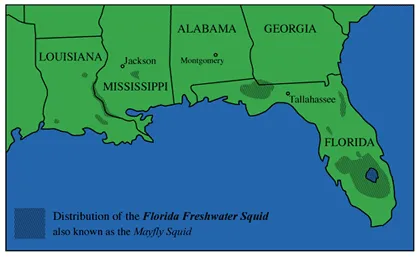
In 1997, researchers confirmed the presence of mayfly squid in Georgia. By 1999, mayfly squid had been reported as far west as Louisiana’s Mississippi River Delta. Estimates of Florida’s freshwater squid population range from 150,000 to 400,000, but all researchers agree that the squid’s population is increasing almost as dramatically as its range. Considering the dynamic nature of Florida’s environment, subject to ever increasing pollution and loss of wetlands, it is remarkable that the mayfly squid continues to thrive. (Recent research33 indicates that one reason may be the ability of the squid’s nerves to neutralize the harmful effects of such substances as mercury.)
The mayfly squid could become a pest species due to overpopulation or, in its new range, encounter a native species on which it has a negative impact, but no hard evidence exists to indicate that Fons volatilis will do anything more or less than continue to adapt inobtrusively to its environment. As Rebecca Chapman once wrote, “the squid is most memorable for its subtlety.” (36)
End Notes
-
Jeffries, David. 1932. A Report on the Origins of New Cephalopod Discoveries. In Cephalopod Quarterly. 98(3), p. 22.
-
Hambly, Bruce. 1984. Results of a Two-Year Study of the Introduced Species “Mayfly Squid.” Florida Department of Environmental Protection Report, Series #84-0139, p. 14.
-
Kennedy, Ann. 2001. Points of Interest. AAA Tourbook: Florida, p. 83 (sidebar article).
-
Brooke, Keith. 2000. The Natural Beauty of Florida: Hiking, Festivals, and More. Pineapple Press, p. 232.
-
Bernhardt, Linda. 1973. The Edith Johnson Legacy. In Journal of Ornithological Studies. 120 (7), p. 216.
-
Johnson, Edith. 1920. The Strange World of the Freshwater Squid. Vigil Science Press, p. 10.
-
Crawford, Henry. 1939. Suwannee Sunset: Collected Essays and Letters. Southern Heritage Press, p. 157.
-
Landrell, Michael. 1918. A Five-Year Study on the Effects of Industry on State Waterways. Fish and Game Commission Report 34, p. 41.
-
Peters, John. 1920. An Analysis of Silt Levels in Strategically-Located Florida Rivers, HQUSACE Publication Bulletin #ER 25-3-20.
-
Johnson, Edith. 1921. Mysteries of the Freshwater Squid Revealed. Vigil Science Press, p. 43.
-
Dickerson, Susan. 1991. The Case for Predator-Prey Confusion in the Research of Edith Johnson. In Mollusca, vol. 14, p. 752, Academic Press.
-
Johnson, Gale. 1999. The Troubled Life of Edith Johnson. In Florida Natural History Society Journal 74(8), p. 413.
-
Sanchez, Robert. 1983. The Chapman Blind: Pros and Cons. In Journal of Cephalopod Inquiry 183(9), p. 642.
-
Chapman, Gregory and Rebecca Chapman. 1937. Initial Observations of the Florida Freshwater Squid in its Natural Environment. Southeastern Journal of Nature Studies 7(11), p. 912.
-
Willis, Sarah. 1949. A Monograph on the Nature and Habits of Juvenile Mayfly Squid. In Journal of Cephalopod Studies 49(2), p. 276-77.
-
Barber, V.C. 1968. Evidence of the Brazilian Influence on Fons volatilis. In Journal of the U.K. Marine Biology Association 32(2), pp. 121-45.
-
Sibly, Charles. 1995. DNA Biochemical Bonding in Related Animal Species. In Comparative Zoology 35(7), p. 314.
-
Westwood, S. N. 1989. The Response of Mayfly Squid Juveniles to Adverse Conditions. In Mollusca, vol. 12, p. 57. Academic Press.
-
Obregon, Rodriguez. The Symbiotic Relationship Between the Giant Amazonian Catfish and the Brazilian Freshwater Squid. In Freshwater Fish Studies 32(3), pp. 351-79.
-
Morris, Allen and Joan Perry Morris. 1999. Exotic Animals. In The Florida Handbook, 27th edition, pp. 473-76. Peninsular Publishing Company.
-
Trainer, Raymond. 1958. The Symbiotic Relationship Between Clarias Batracluus and the Mayfly Squid: The Implications for Studies of Changed Environments. In Kevin Darden and Michael McCloskey, eds., The Habits of Cephalopods, pp. 176-93. Academic Press.
-
Fisher, R.J. and M. Fernback. 1955. The Perambulatory Dispersal of the Mayfly Squid. In Manchester Journal of Aquatic Fauna. 12(5), pp. 200-27.
-
Peterson, Richard. 1997. A Monograph on Emerging Theories of Ocular Pecularities in Exotic Cephalopods. In Journal of Exp. Biology 200(3), p. 845.
-
Stratton, Scott. 1998. The Case for Limited Eco-location Abilities in the Brazilian and Floridian Freshwater Squid. In Marine Biology 75(2), pp. 371-89.
-
Blake, William. 1989. The Collected Works of William Blake. Tartarus Press, p. 354.
-
Norstrom, Mary. 1976. A Study of Mayfly Squid Hunting Techniques. In Cephalopod Studies 37(2), pp. 157-92.
-
VanderMeer, Jeff. 2000. A Monograph on the Intricacies of the Mayfly Squid’s Three-Day Mating Ritual. In Mollusca, vol. 23, pp. 352-88. Academic Press.
-
Nelson, Carol. 1999. Canned Squid: The Impact of the Davids Brothers’ Dream on Lake Okeechobee. Suwanee River Press, p. 175.
-
Ibid, pp. 192-94.
-
Ibid, p. 210.
-
Ibid, p. 235.
-
Ibid, pp. 251-53.
-
Sanderson, Harold. 2001. A Guide to Sebring Attractions. Highlands Press, p. 110.
-
Ulmann, Alec. 1971. The Sebring Story. Childers Publishing, p. 45.
-
Purdum, Elizabeth D. 1998. Atlas of Florida. Unversity Press of Florida, p. 228.
-
Chapman, Rebecca. 1973. The Journals of Rebecca Chapman (ed. Cynthia Chapman), McGraw-Hill, p. 3.
Footnotes
-
Contrary to anecdotal reports from the time period, Flagler did not “keep two mayfly squid in an aquarium in his Pullman car” as he inspected progress on the railroad. The squid were almost certainly Japanese in origin and kept in the kitchen car for conversion into calamari. ↩
-
The Cephalopod Studies Institute of the Americas has set out specific provisions that squid species names be capitalized. However, for consistency I have adopted the more common practice of not capitalizing the names of animals, including squid. ↩
-
Given the increasing urgency of studies that examine the interdependence of human beings and the environment, human predations on the environment, and related issues, I cannot stress highly enough the need to look at “the whole picture.” ↩
-
This despite the adamant veto of her mentor, Dr. Small, who wrote to her in a letter dated July 12, 1915, that “you will spend half your time cursing your decision and the other half making up disreputable theories.” ↩
-
Johnson is clearly one of American Natural History’s tragic figures. Many of her friends believe that her downward spiral began with the distracting effort she put into Katherine B. Tippetts’ failed campaign to become the first woman elected to the Florida House of Representatives (1922). Later, in 1927, beset by personal problems, Johnson returned to her hummingbird studies but found herself physically incapable of the concentration required for prolonged research. She died in poverty in a flophouse outside of the town of Perry, Florida, just a year before her mentor, Dr. Small, passed away. ↩
-
The original prototype of the Chapman Blind is currently on display at the Florida Museum of Natural History (Gainesville, Florida). It lies next to an ancient dugout canoe built by Muskogee Indians and bears this description on its placard: “The Chapman Blind (1934): Conceived by Dr. Gregory Chapman and Dr. Rebecca Chapman, this underwater blind inspired later marine biologists such as Jacques Cousteau and Alexander Manard.” It does not indicate how the blind inspired Cousteau and Manard. ↩
-
The 1920 infestation of Florida by the Texas cattle tick resulted in Georgia building a barbed-wire fence on its border with Florida to keep out afflicted livestock. The 1929 infestation of the Mediterranean fruit fly cost orange growers millions of dollars. These events and others like them made many private entities wary of introduced species. This attitude created a narrow window of opportunity for naturalists like the Chapmans to receive private monies for research into the potential threat posed by species such as the freshwater squid. ↩
-
Smythe did write about his experience and, according to his son Theodore, the resulting self-published chapbook, The Day I Found a Mayfly Squid in My Aquarium: Bait Memories, sold steadily for years from the bait shop payment counter. ↩
-
“Lula brasileira de água fresca,” first identified by the great 19th century Brazilian biologist José Cabral do Gorgulho Cacarejo, lives in the southern tributaries of the Amazon River and is even more elusive than the mayfly squid. ↩
-
Due to the substantial trade in coffee between the São Paulo/Rio region of Brazil and the United States. ↩
-
As happened in the case of the Indian sugarcane rootstock weevil borer, with disastrous consequences. ↩
-
In 1998, the St. John’s River Water Management District issued a mayfly squid alert because the mating season had produced such large quantities of juveniles that they had clogged culverts, waterways, and run-off canals. ↩
-
As is too often true, the freshwater squid reference occurs in a footnote to a paper on the catfish and was only brought to my attention by a sharp-eyed cephalopod studies colleague, Paul Larsen. ↩
-
Earlier claims by R. J. Fisher and Michael Fernback that the mayfly squid could “walk between water sources using its tentacles like grappling hooks on a horizontal mountain face” were, in fact, based on observations of young squid that had been dislodged from their catfish perches but had been able to sustain themselves in puddles large enough to trigger growth. Observers like Fisher and Fernback, encountering these squid, assumed they were in transit from one body of water to another.(22) ↩
-
I once received a letter from a fisherman on Lake Orange who told me that mayfly squid followed his boat and fed on sandwich scraps thrown into the water. ↩
-
This reaction can be especially unpleasant for snorkelers who are simply trying to get a better view of the squid. ↩
-
The mating cycle is discussed within the context of the Festival of the Freshwater Squid, below. ↩
-
The Siamese fighting fish also employs bubbles in its courtship. The male makes the bubbles and arranges them into a dense, floating cluster. He squeezes the female until her eggs pop out, one by one. He then fertilizes the eggs with his mouth and places one in each bubble for protection. ↩
-
Bolstered by the World War II demand for additional food sources. ↩
-
Three times voted into the Florida Senate on the Republican ticket. ↩
-
Such brashness was typical of the Davids brothers. Both had dropped out of college in their early 20s to pursue get-rich-quick schemes that often ended in disaster. They had escaped military service by dint of their myopia and influential father. As they entered their thirties, it became apparent even to the Davids’ friends that planning appealed to the brothers more than end results. ↩
-
Lynch also created tools specific to squid harvesting. “Squilts” were long wooden stilts that allowed the squiders (as the Davids called their squid mill workers) to walk through the water around the outside of the squid mill and retrieve any wild squid that had been caught between the mill’s two outer walls. To retrieve the squid, squiders used a long metal tube attached to a net “mouth” that could be opened or shut manually using a squeeze handle. ↩
-
George Jenkins, Publix founder, had been a contributor to Bill Davids’ political campaigns. ↩
-
That Lynch’s squid mill design was unnecessarily complex can be confirmed by even a casual glance at the sleek squid mill designs implemented by the Japanese in the 1960s. ↩
-
An article in the December 12, 1951, St. Petersburg Times applauded the “energy of the Davids brothers” and the “potential positive impact on the South Florida economy,” but added the damning opinion that “the end product of this effort is not particularly palatable.” ↩
-
An abbreviated version of this section first appeared in The Orlando Sentinel on May 28, 2000, under the headline “Sebring Squid Festival a Favorite of In-State Tourists.” ↩
-
In fact, the town’s founder, G.E. Sebring, discovered and fell in love with the area while on a boat trip. ↩
-
More than 50,000 Le Mans fans come from as far away as Europe and Japan for the two-week event. ↩
-
Thus far, the Sebring Festival Committee has been unsuccessful in its efforts to encourage the state legislature to pass a resolution proclaiming the second Saturday in May “Florida Freshwater Squid Day.” ↩
-
Another drama has been occurring beneath the surface throughout the mating process-trout and bass like to congregate at the edges of a squid mating group and pick off stragglers. ↩
-
With the advertising legend “a favorite of maniacs” printed on the wrapper-almost certainly a bad translation by the Japanese manufacturers. ↩
-
The challenge, from a naturalist’s point of view, is to ensure that such enthusiasm translates into a true spirit of conservation. From the amount of paper and plastic trash lining the lake shore the next morning, I have to conclude that this spirit may be lacking among festival participants. ↩
-
As documented by University of New Hampshire biochemist Eric Schaller, publication of results pending. ↩
Copyright © 2001 by Jeff VanderMeer.