February 19, 2005
‘Rise of the Swans’
Doing Bird with Jeff Lint
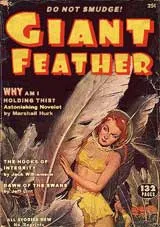
Jeff Lint’s softly apocalyptic story ‘Dawn of the Swans’ first appeared in a 1958 issue of speciality pulp mag Giant Feather and was later collected in the book Mask of Disapproval (as ‘Rise of the Swans’). In this unsettling yarn a thick, wet fog rises from the great park lake at the centre of the city in which the narrator lives, enveloping the city for three days. All electronic devices are damped out and occasional screams and bursts of sarcasm are heard from the smog. When the marsh mists finally disperse the narrator finds that the city has been overtaken by sentient swans. Our hero is Mario Drake, a survivalist type who, suspecting some government chemical experiment of the Winnipeg variety, has used the three days to arm himself to the teeth and is dismayed to find the city towers merely ticked with swans like white pterodactyls.
After a disillusioning patch during which he tries to organise his fellow humans into a revolutionary unit, he finds that they are just as boring and nerveless as before the Dawn. Meanwhile the swans are not lording it over the humans, and actually seem quite organised and honest. The story really kicks off when Drake has an audience with Quine, the King Swan, though this includes an absolutely mind-bending debate on the nature of time:
‘A clock is a cage placed in a flowing stream; holding nothing, stopping nothing, not even for a minute.’
‘A man’s smiles don’t queue up — they all happen the same place. Time is what separates them.’
‘The same conclusion directed backwards can be used as an excuse. One season does not outwit another.’
‘Only the forgetful grant clemency to the past.’
Assembled onlookers are barking, honking and hissing throughout the exchange, but only the swans are laughing. By the time Quine has told Drake ‘Even a rose shoulders space for itself’ Drake is suffering a delirium in which he believes the black knob on the top of Quine’s bill is a tiny melted Bible, a misperception Quine begins to correct before realising he himself doesn’t know what the hell it is.
Drake organises a system of water channels to run alongside the city sidewalks and is soon an honorary general with white chevrons on his shoulders, much to the disgust of the black swan general Castalan. Indulging in revelry among these bleached pteranodons who are now reorganising human affairs everywhere, Drake learns their weird and graceful worldview and suffers intense origami dreams in which angles are bent so far the wrong way they end up right. He falls in love with a girl swan called Ymel, mesmerised by her puffy white cheeks which he names ‘Bosun’ and ‘Freddy Armitage’ (though they never respond). He is also happy with the marriage because swans are known to be monogamous. A child results, a human girl with the wings of a swan: the first true angel.
So much for the basic story.1 However, it’s thrown off-beam by a misprint which appeared at first publication in Giant Feather magazine, and which was carried over into the Disapproval collection: Drake’s parents are said to have died when he was young, after which he was ‘raised by two ants’. This unconventional upbringing throws unintended motivational vertices over Drake’s behaviour in the story, suggesting an unusual psychology in the hero. Lint, however, had written Drake as an average sort of man. Later in the novel, a proof-reader must have actively changed ‘aunts’ to ‘ants’ to make it consistent with the term’s earlier appearance, so that Drake sits on a stone sky balcony musing, ‘If only those crazy ants of mine could see this.’ Thus he was not only raised by ants, but ‘crazy’ ants. The ant error totally undermines the philosophical thrust of Lint’s story, making it difficult for many readers to identify with Drake or to trust his observations. Some critics (eg. Cameo Herzog in the article ‘If I Could but Kill’) have suggested that Lint deliberately included the notion that Drake had been raised by ants, then had later thought it was a crappy idea and blamed it on the sub-editors.
Edward A. Clark has proposed that the entire business with the swans is being imagined in Drake’s thick head. (Cameo Herzog writes with the casual certainty that Drake is dreaming it all up ‘in the bath’.)2 Drake gains in status by these imaginings, especially when one considers that the status is not bestowed by human beings. If it is a dream, are there clues to Drake’s real circumstances hidden in the dream? There are several references to glass, lenses and spectacles (the scholarly swan Lupar wears wireframed specs). Is Drake an optometrist, or is this a nod to altered perceptions; or both? In my opinion Lint would not resort to such a cliché unless it was to cloak a more interesting possibility — that the swan empire has long existed and that human beings are considered creatures of lurid myth and science fiction. Subtle clues to this can be seen in the bacchanalia scene, where it is claimed that Drake scrutinises things with his ‘third eye’, that he has a ‘hollow leg’, and that his fully engorged cock reaches a mere ‘seven inches’. This chimera makes it clear that we have gone from a human empire, to swan/human coexistence, to a swan empire without the existence of humanity, the deeper we have explored the story’s subtext. Lint’s own ambiguity about the human race is crystallised in a less comical and more affecting chimera — that of the human/swan/angel creature. Did a part of Lint want humanity (‘the maker and eater of lies’) to exist in some form after all?
When asked in an interview with Daniel Guyal whether Drake is hallucinating the swan uprising, Lint replied gloomily ‘We’ll probably never know.’ Then he perked up and added: ‘But seriously, no. No, he isn’t.’ (Guyal reports that Lint then began making a strange ‘keening’ noise while leaning forward and staring at him with gluey eyes of need.) This does not eliminate the possibility that the swans are hallucinating the man.3
Lint scholars have rampaged over the Drake/Quine debate. Believing that he argues for his race, Drake tells Quine that laws and systems are ‘not personal’.
Quine replies: ‘Everything’s personal, Drake. Everything that happens to a person.’
The second half of the story includes a tribunal presided over by a strange, furless and palpitant badger. In fact this creature is so cute that no-one in the courtroom can concentrate enough to be efficient, serious or bad-tempered. The whole thing becomes vague and oddly hysterical. Peculiarly accommodating remarks gum up the proceedings. The camera’s eye of the story seems to hove in on Drake as he melts into a slow-bloom happiness with the new state of affairs in his nation. The swan empire seems to be stupid and harmless, rather than stupid and malicious. Indeed the cygnutopia of ‘Dawn’ is a rare example of Lint looking amiably upon a social set-up, all the more unusual for his aliens’ tendency not to bother landing on Earth, and his spacemen’s rather jaded view of alien cultures (‘Aluminum flagstones? What’s the point?’) And it seems to have fallen together. At story’s end Drake and his family look into the night sky. ‘Stars are accidents. How many?’
As Alfred Bork has said, ‘Lint shows us the complete lack of paradox in modern life which is evident if we look at it honestly and with an acceptance of its detail.’
Lint took the arterial route to people’s honesty in books as chemically complex as diamondback venom, a gasping refreshment next to the works of Asimov, Amis, DeLillo and other literary flatearthers. ‘Turn the day about with these cold star swine?’ he wrote. ‘I do not need to be alone for my smile or frown to be in my own hands.’ His characters spoke words from what he called ‘the other side of the face’, something we could use in an age when any long thought with the temerity to emerge is cut up like a worm, action is like lighting a match on a mirror and truth is regarded as the worst version.
In bringing on the swans, Lint retakes that old world in which actual progress was maybe possible. Man and the swan seem in agreement on attempting to make life a bit more bearable rather than fussing about whether humanity represents the pinnacle of creation: this issue can be sorted out later if, by some ‘bizarre yet boring’ twist, the matter becomes important. (That notion of ‘bizarre yet boring’ recurs in Lint as the telltale quality of human affairs; its drab flag and flavour.) Bork has observed that ‘the taboo position of honestly admitted powerlessness blasts a purifying light through Lint’s novels’. This allows Lint’s protagonists to start a tale with an accurate view of the circumstances to be confronted (a point which other author’s protagonists rarely reach by the end). Critics have complained that Lint’s stories lack conflict — they do, in fact, conflict with every story written by everyone else.
Footnotes
1 Some of which ended up in Chris Caccamise’s crappy but successful novel-length plagiarism, Empire of Flamingos (not to mention the appalling British feature-length cartoon Attack of the Piglets, voiced entirely by Bernard Cribbens).
2 Lint friend and fellow pulp author Marshall Hurk wrote a variation on the ‘locked room’ mystery, in which Cameo Herzog seems to come up with an idea, in a bare, locked, soundproofed room. All means of communication are tested, all possibilities eliminated, and yet Herzog has thought of one more idea than he had when he entered the room. The trick, of course, is that this is another man who happens to have that name. Hurk had never described the man’s appearance, nor explicitly stated that the prisoner was the critic and journalist Cameo Herzog.
3 Such hallucinations of brave men feature in Lint’s prophetic ‘Too Fat to Riot’.
Sources
Mask of Disapproval, Jeff Lint (Rich & Cowan, 1961)
Giant Feather (Collected Tales), edited by Allen Walsh (Chaffee, 1976)
‘If I Could but Kill,’ Cameo Herzog (collected in Dust We Shall Become: Collected Reviews of Cameo Herzog, Balkan Books, 1969)
‘Look Here, Upon This Picture,’ Marshall Hurk (Bewildering Stories, 1959)
‘Deep Vanishing’ in Jeff Lint’s Science Fiction, Alfred Bork (Portland State University, Oregon, 2003)
‘Swans, Apes, What’s the Fucking Difference?,’ Ian Watson (Jellysump Zine)
‘Swan Lee, Swanley and Swans: the Barrett/Kent/Lint Connection,’ Debra Copelan (J-Lint fanzine, 1994)
Copyright © 2005 by Steve Aylett.