August 16, 2002
The Leviathan Anthology Series
An Overview
In the Beginning…
Oddly enough, the Leviathan anthology series grew out of the 1992 Clarion East Workshop, during which a fellow student, Luke O’Grady, and I discussed doing a magazine. In 1993, I proposed (or Luke proposed — hard to remember who said what first) publishing an original fiction anthology. Doing so would also in effect resurrect the Ministry of Whimsy. The Ministry had been moribund since 1991, when we had published the second and last installment of the fantasy magazine Jabberwocky. (That in turn had signaled the end of the second phase of the Ministry’s evolution, the early history well documented at www.ministryofwhimsy.com.)
Early possible names for the anthology included “Quiddity,” “Distant Bells,” and “Questions.” In other words, “Leviathan” really was the best possible choice. The choice of “Leviathan” as a title also allowed us to establish our focus — or lack of one. As it states on the copyright page of Leviathan 1:
The Leviathan anthology series will attempt to cover many different themes and concerns without the kind of specific restrictions that often prove the downfall of more focused theme anthologies. Leviathan takes its name from the second, less well-known definition of “that which is too large to be seen in its entirety; important in scope or intensity.” Thus, each anthology shall attempt to map part of the leviathan that is fiction.
Nothing particularly ambitious about that goal! And, of course, we had made up this supposed second definition of Leviathan to suit our scope.
Leviathan 1 may indeed have been the most ambitious of the three anthologies in the way it mixed mainstream and fantastical stories. Using the ambiguous theme of “Into the Gray,” Luke and I chose 10 stories about discovery, using as our title page quote “Every perfect traveler always creates the countries where he travels” (Nikos Kazantzakis). We then arranged the stories from least fantastical to most fantastical and used a mythical piece by Joe Nigg as our introduction. By ordering the stories as we did, the reader went from mainstream relationship stories to, by anthology’s end, Stepan Chapman’s squid-headed people story, “The Chosen Donor,” without suffering the bends. (The true ending to the anthology would have been M. John Harrison’s “A Young Man’s Journey to Viriconium,” but Luke didn’t like the story, I’m sad to say.)
We needed art to match the contents, so we managed to buy a surreal piece from Alan M. Clark. Duane Bray, a friend from high school who now works for one of the largest design firms in the world, did the layout and design for the cover. Duane would wind up doing the design for every trade paperback the Ministry published (except Punktown), including all three Leviathans. He is the main reason our books looked good enough to compete with any publisher in the world.
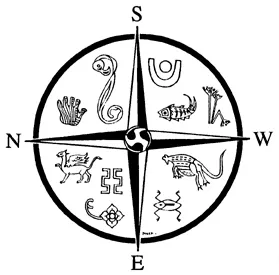
On Leviathan 1, artist and designer both had another issue to deal with. The main financial backer of the anthology wanted to incorporate a compass into Alan’s cover art. We had had a compass done as a frontispiece by Penelope Miller (my mom, I should reveal), but this backer wanted it somehow Photoshopped into Alan’s art, or for Alan to somehow take the photograph of his art (he didn’t have the original) and paint a compass onto it! There followed a rather ridiculous argument, ending in victory for the sane…
Reaction to Leviathan 1
Needless to say, the reaction from mainstream and genre critics was often one of bewilderment, although many reviewers did get what we were trying to do (in part to say that a story can be fantastical at the level of metaphor alone). Tangent and Literary Magazine Review, diametrically-opposed publications, both loved the anthology. Tangent gushed that Leviathan 1 was “one of the best collections of quality fiction at any level that I’ve seen in years. Not since the early volumes of Damon Knight’s Orbit series has such a consistently well-written set of stories appeared under one cover.” Literary Magazine Review wrote, “A big, handsome devil. Just about everything wins reader confidence early and then maintains it with intelligent development.” Mark Kelly, Locus reviewer, had good and bad things to say in a review that was cautious but fair. Paul Di Filippo, in the Council for the Literature of the Fantastic Newsletter praised many of the stories — “Every story is well-crafted and inherently substantial; it’s easy to imagine any one of them appearing in, say, The New Yorker” — but thought the anthology displayed a lack of focus. Albedo One, an Irish SF magazine, disliked what it saw as self-indulgence on the part of our authors. The local Tallahassee Democrat ran a noncommittal review by chopping off the reviewer’s ringing endorsement in the last paragraph and using the inappropriate headline of “A Nightmarish Vision: Anthology’s Spooky Stories Bring Bad Dreams to Life.”
Reader response centered around dead animals, for the most part. Barbara Rosen wrote in to say, “…at its best, Leviathan is full of breathtakingly good writing, odd imaginative quirks, mystery and redemption. At its worst, the writing is still breathtakingly good, but oh, my!” “Oh, my!” referred specifically to Tanyo Ravicz’s story “Passion for Puppy,” in which the narrator strangles a dachshund. Interestingly enough, despite a number of human deaths in the anthology’s stories, over a dozen readers wrote in to protest the dead dachshund, not a one to protest the dead humans.
The most surprising thing about Leviathan 1, in retrospect, is that over the years, several of those stories have proven to be part of something larger. Ursula Pflug’s “Telepathic Fish” is part of her just-released novel Green Music from Tesseract Books, Green Music. Stepan Chapman’s “The Chosen Donor” eventually saw print as part of his novel The Troika from my own Ministry of Whimsy Press. Richard Winter’s “New Bow” became part of his book Ila from Impatiens Press. Next most surprising? Despite any award consideration and very negligible attention from the year’s best anthologies, the anthology continued to sell at a steady rate, bolstered by word of mouth. It still amazes me that people will come up to me at conventions and mention how much they enjoyed reading Leviathan 1.
The worst part of Leviathan 1? The promotion. Our ads looked like crap because I did them myself. We also had 200 copies of the anthology shipped to a World Fantasy Convention for use in freebie bags given out to attendees. However, for some reason, they weren’t put in the freebie bags and on the weekend in question Alan M. Clark called us from the convention asking me what I wanted to do with them. The organizers had gotten hold of him because his art was on the cover. I made the mistake of saying “put them on the flier table as freebies.” Apparently, dealers converged like sharks and made off with dozens at a time, selling them for months through catalogs or at conventions. Certainly, we got some extra distribution that way, but it didn’t help our bottom line.
That there was a need for Leviathan seemed obvious. The publications with which Leviathan was sometimes compared — Crank! and Century — did not fulfill the same niche. Century focused on magic realism — stories in which a fantastical element entered into the real world. Crank! published mostly gonzo science fiction. Both were great, but neither publication, in my opinion, was sympathetic to surrealism. (And, frankly, the good-natured joke around Ministry HQ was that eventually, even publishing once every four years, Leviathan would have more volumes out than Century had issues, Century being “quarterly” as in “once every 25 years”. I also recall the always self-absorbed Bryan Cholfin, Crank! editor, rudely ripping a copy of Leviathan 1 out of my hands, running through the list of contributors, and saying, “I don’t know who these people are? Who are these people?”, before a ReaderCon panel.) The Silver Web, edited by Ann Kennedy (now VanderMeer!) probably came closest to Leviathan’s focus, but Ann focused on artwork and poetry as well as fiction, and all of her fiction was surreal.
Leviathan 2
In between Leviathan 1 and 2 lies the phenomenon known as Stepan Chapman’s The Troika. Leviathan 1 had served another purpose: it had fully awakened the Ministry of Whimsy from its slumber. Over the course of just a few years, we had published Bruce Taylor’s short story collection The Final Trick of Funnyman, a couple of well-received chapbooks, and developed an innovative web site… as well as survived The Troika. As the single most successful book in the Ministry’s history — winning the Philip K. Dick Award — The Troika had both been a crowning triumph and a resource-devouring cause of near exhaustion.
All of which explains why Leviathan 2 occurred in 1998, not in 1995, as originally planned. Clearly, we had to move away from the idea that the Leviathan series could be an annual event. Clearly, too, co-editors were going to be as short-lived as drummers for Spinal Tap. Luke O’Grady disappeared into the Canadian wilderness and, although he’s still living, I have no idea where he is or what he is doing.
Enter Rose Secrest, who would provide support for and help edit Leviathan 2. Which would not be easy. I had decided on the “theme” of novellas. At the time, I was writing the novellas that would comprise City of Saints & Madmen and was having difficulty placing them with anyone. I figured I couldn’t be the only one with that dilemma and resolved to provide another market for long fiction. Rose was lucky in that I only let her see the “finalists,” so to speak. Me, I was not so lucky. (Nor Ann, who is really an unacknowledged co-editor on all three volumes.) During the reading period, I read or skimmed over 2,500 novellas. Out of those 2,500 novellas we wound up taking only one — L. Timmel Duchamp’s “Portrait of the Artist as a Middle-aged Woman.” The other three pieces — from Rhys Hughes, Richard Calder, and Stepan Chapman — I solicited from the authors. David Pringle then provided a great introduction about novellas in general. After going through such an intense reading period, I did begin to think that the tongue-in-cheek idea we’d had early on to present rejection slips at conventions to people we didn’t want to submit to the anthology had some merit. The main problem, however, was not really quality of writing, but that we wanted to produce something different. Many of the submissions were just too traditional in nature.
By this time, the whole idea behind Leviathan 1 having had time to infect people’s minds, Leviathan 2 received a great deal more attention, becoming a finalist for the British Fantasy Award and certainly not a handicap when the Ministry — primarily for The Troika — became a finalist for a World Fantasy Award. I was also proud of the interviews with the authors that we included in Leviathan 2 — Rhys Hughes, L. Timmel Duchamp, and Richard Calder had never been interviewed before.
With Leviathan 2 as with Leviathan 1, we had no desire to promote a particular school of writing, or to invent one. We did not want to be defined as “slipstream” or as “magic realism.” We did not want to be associated with the New Wave (although we liked the New Wave) nor with humanist SF nor with any resurrected idea of a new “Last Dangerous Visions.” If we wanted to be defined as anything, it would probably be “surreal,” an idea reflected in our covers by Alan M. Clark and Scott Eagle. We definitely did want to push the envelope and be experimental, but it wasn’t our entire reason for being. In short, we wanted to publish unusual, beautifully-written stories that displayed the best virtues of what is typically thought of as “genre” and what is typically thought of as “mainstream literary.” But with no didactic agenda.
Leviathan 3
Leviathan 3 is our great Decadent volume — our anthology of excesses. Armed with a new co-editor — Forrest Aguirre — and a new publisher for the Ministry (Prime), we decided to take the anthology to yet another level, abandoning forever the idea of a logical set of themes that might map the entirety of fiction. Using Zoran Zivkovic’s library stories as the anthology’s backbone, we set out to find stories that generally reflected the same themes. I have just been introduced to Decadent literature in the last couple of years and Forrest had been steeped in it for quite awhile, so it seemed natural that a Decadent element would enter the anthology. Especially because the Decadent movement and the Surrealist movement had a lot in common — cross-pollination made a lot of sense.
Praise for Leviathan 3 has gone much the way of previous volumes, although with the sound turned up, so to speak: praise has been more extravagant, brickbats more stern. As Stepan Chapman, the only writer to be in all three Leviathans, likes to say, “There’s something in Leviathan 3 for everyone to hate.” And to like.
The Future of Leviathan
Leviathan 3 has also signaled a new period of transition for the anthology series as, for the first time, I will be the editor leaving the project. Forrest Aguirre will take over sole editorship of the anthology with Volume 4 (theme: Cities). The Ministry of Whimsy itself has a new publisher: Prime, headed up by Sean Wallace. Designer Garry Nurrish will join Duane Bray in creating distinctive covers and interior layouts. Much to Sean’s credit, he didn’t have an instant stroke when we told him Leviathan 3 was 482 pages long — a true leviathan. (Nonetheless, I would have liked to have seen the look on his face at that moment.) Through Prime, the future of the Leviathan series seems assured, as does a more regular publishing schedule.
As for why Leviathan should continue to exist and to publish idiosyncratic fiction, I think the answer is clear: no anthologies currently in existence, or most magazines for that matter, have the same focus as Leviathan: an unflinching ability to publish truly surreal stories. No other publication is willing to take a chance on the stories Leviathan is willing to take a chance on. Even more importantly, the emergence of writers like L. Timmel Duchamp, Michael Cisco, Rhys Hughes, and Steve Aylett, and the renewed interest in the work of writers like Stepan Chapman, M. John Harrison, Zoran Zivkovic, and Rikki Ducornet has greatly enhanced the chances of Leviathan becoming even more popular. Of course, such an environment also breeds imitators — those who either consciously copy Leviathan’s example or do so unwittingly because of excitement about new writers who express the same aesthetic. (And as we may have, in some ways, copied the example of New Worlds.) All of which is good news for those who care deeply about realizing fantastical literature’s full potential. There can’t be enough outlets for work of this nature.
For me personally, working on Leviathan has meant an enriching exchange of creative ideas with the numerous co-editors, artists, and design people who have worked on the anthology. It has also meant meeting people I would never have met otherwise — for example, Joe Nigg, Richard Calder, L. Timmel Duchamp, Tom Winstead, Stepan & Kia Chapman, Ursula Pflug, and Richard Winters. Even more importantly, from a purely selfish perspective, without Leviathan I might never have met Eric Schaller, who has been my main artistic collaboration on my Ambergris cycle of stories. My thanks to everyone involved with these anthologies. From day one, the experience has been a pleasure.
Copyright © 2002 by Jeff VanderMeer.