December 12, 2001
Symphony no. 6 in C minor ‘The Tragic’ by Ludwig van Beethoven II
Philips’ “Forgotten Masters” Series
Perhaps if a poll were to be taken of professional musicians, less than one per cent would admit to having heard of this composer. Probably a large proportion of the rest would believe the poll to be merely a practical joke of some kind. These same musicians would probably be astounded to discover that Beethoven II was the possessor of undoubted talent, and had composed at least one work worthy of the title ‘masterpiece’ and many others, like this symphony, of great interest. We hope that this recording will help to establish this symphony as a standard work of the concert repertoire.
Perhaps our musicians would ask why a composer of such talent has remained almost completely unknown. We can only surmise that his extremely unfortunate name has quite a lot to do with it. Whether he was named out of an impulse of sadism, or as a genuine tribute to a great composer, we do not know. We know only that it was yet another burden that was added to the many that Beethoven bore throughout his life.
Ludwig van Beethoven II was born in Mannheim in 1828. His father, Hans, was a piano tuner, and young Ludwig was born into a very musical family. At the age of three Ludwig began receiving piano lessons from his father, but the man’s dreams of a prodigy remained unsatisfied as Ludwig showed little musical talent. As Ludwig grew up he began to take an interest in law. He begged his father to be allowed to study at law school, but the man was adamant, and forced Ludwig to take up the violin. Beethoven, in his Scenes from an Unhappy Childhood, has touchingly described how he used to get up in the night and retreat to the little attic, there to read books on law until the early hours.
Eventually realising that his entreaties were hopeless, Ludwig resigned himself to a musical career. His violin playing improved and his latent musical genius began to manifest itself; he soon won a grant to study in Vienna.
It was at this point that he was viciously struck by one of the cruel blows of fate that were to dog him all his life. In the excitement of leaving for Vienna, Beethoven trapped two of his fingers in the carriage door. The bones were broken, and the wound soon became infected. Within a week he had lost two fingers of his left hand. The remaining fingers were hopelessly deformed. However, it was this accident, which seemed so terrible at the time (in his diary Ludwig writes: “I destroyed my life in a carriage door”), that was responsible for Beethoven turning towards composition.
His earliest works are uniformly uninteresting, although one can hear the young Beethoven trying to express his anger at the injustices of his life, and it is not until the Fourth Piano Sonata (with its unusual allegro con dolore first movement) and the First Symphony, The Pathetique, that he showed any talent for composition. His next work, the Violin Sonata, was the first to achieve contemporary recognition, which it did by virtue of its fascinating slow movement, the Marcia Funèbre.
One can see from his writing that at this time Beethoven was going through a very difficult and unhappy time as far as his amatory life was concerned. At the age of twenty-five, after his second broken engagement, he wrote the Konzertstück for Piano and Orchestra, in which much of his youthful suffering was expressed. Although this work is obviously very good, especially the mesto middle section, the piece has never been performed in full. Beethoven was never an expert orchestrator: what other composers knew instinctively, he had to study hard to accomplish. In this piece the violin parts in several places would be possible to play only if the violinists were to have the same deformity of the left hand as that suffered by Beethoven. Also, Ludwig suffered from not having learned the piano as a child. There is a great deal of bravura piano writing, but it is clear that Beethoven did not fully understand the limitations of piano playing, and the piece is completely impossible for a single pianist to play. Attempts have been made to play this part utilising three or even four pianists, but for various technical reasons these have not been a success. Louis Spohr made a little-known arrangement of the work for a chamber orchestra composed of flute, two clarinets, bassoon, wind machine and strings, but little of the music’s splendour comes through.
Despite his drawbacks so far as orchestration is concerned, it is clear to us today that Beethoven had many progressive ideas about music. One can see from his book Angst and Music (now out of print) that he even toyed briefly with the idea of atonality:
Last year I was conversing with my good friend Schönfeld, when he communicated to me some remarkable ideas concerning the very nature of our art. He felt that for some time now the fundamental part of music, that is its diatonic tonality, had been strained to the point at which it no longer functioned correctly. He mentioned some of the modern composers such as Herr Brahms. Although it is clear to me that Brahms is only a fashionable composer of minor interest, there are other artists of extreme importance, like Nagel and Haubenstock, to whom this applies with equal correctness. He explained that the musicians of the future would develop ideas of tonality that would have no relationship with our method of related keys. This music, he felt, would probably be called “non-tonal”. I had to concede that he showed remarkable perspicacity, and felt for a moment that perhaps it would be in my interest to begin some works of this nature, thus being credited with this remarkable discovery, but owing to a greatly painful hornet sting which I sustained during the course of this interesting conversation, was unable to leave my bed for a full week. Schönfeld again visited me and told me that he had been diligently applying himself in the production of “non-tonal” music, and began to express ideas about a series of all the twelve degrees of the gamut, which, if I understand his ramblings correctly, he thought could be arranged in various forms, inverted, back-to-front, etc., and combined to form both melody and harmony. It is my own opinion that Schönfeld was in a febrile state and had been over-diligent in his studies to the detriment of his mental condition, and that he would be well advised to take a rest in bed. This I told him, and added as a little joke that perhaps he should have been the recipient of the hornet’s wrath rather than I. He seemed greatly offended at my words, and since then has not communicated with me.
It was now, in 1853, that Beethoven’s parents both succumbed to a local plague of typhoid fever. Although the death of his parents was a terrible shock to Beethoven, a shock that plunged him into despair, at least he had no financial worries at this time, owing to the fact that his father, having some years ago invented the iron piano frame, had amassed a sizeable fortune, which he left to his son.
In expectation of his forthcoming fortune, Beethoven arranged for a performance of the Second Symphony (one of his poorest works) which involved eight hundred and forty performers. The concert was a disaster. Although the audience was very small, such a riot ensued that members of the orchestra were severely injured, the hall was damaged and the box office forced open by the angry crowd, and all the evening’s takings stolen. Beethoven was sued for damages by ten members of the orchestra, and found himself in the position of owing the total amount for the hire of the hall and the fees of the artists.
It was a few days after this terrible experience that Beethoven was informed that owing to a technicality his father’s will had been declared invalid and the money reverted to the state. Now Ludwig had no way of recouping his loss, and apparently spent some years in a debtor’s prison.
On coming out of prison, Beethoven found that his fortunes appeared to take a change for the better. He received the patronage of Anton Goldschmidt, a wealthy supporter of the arts and sciences, and also met and fell in love with Pauline von Birnitz, a lady of high social standing. Of this meeting Beethoven wrote in his diary: “This evening I saw an angel, fell, and know that I shall remain at her feet for the rest of my days.” But when Beethoven began to court the lady’s favours, he was somewhat perplexed to find that her attitude to him was both patronising and distant. However, he resolved, with courage, never to cease his pursuit of her, no matter what the cost to himself. The touching document he wrote at the time is printed as an appendix to Angst and Music: “Though the terrain be hard, the privation terrible, yet I have no choice but to go where she goes, to see what she sees, to breathe the very air that is perfumed by her presence.”
During this period of resolve (not untinged with optimism), he composed the Fourth and Fifth Symphonies and also the Serenade for Violin and Orchestra, which was subtitled: For Pauline On Her Birthday. When this last work was almost finished, he suffered a severe chill which confined him to his bed, and caused him to be unable to complete the work until several months after the lady’s birthday. Her displeasure at his tardiness was increased by her disapproval of the progressive harmony employed in the work, and she promptly broke off her relationship with him. At almost the same time he lost the patronage of Goldschmidt, owing to the fact that Beethoven had previously persuaded him to invest a great deal of money in the wet-plate shadowscopy process, which at that time had been seen as a possible alternative to the new science of photography, thus causing his patron to lose a great deal of money.
Beethoven was made prostrate by these two blows. His condition was made even worse when he discovered that his new found social standing was being destroyed by Fraulein von Birnitz, who was apparently the source of several rumours concerning Ludwig’s lack of virility and unusual sexual proclivities, which were at that time circulating through the higher strata of German society.
This was the time of the first of Beethoven’s suicide attempts. The composer writes (in Diary of a Sad Man):
One morning I awoke from a particularly troubled sleep, and I knew within myself that this would be my last day in this world. I had a long piece of hemp rope, which I had kept within my view for the whole of the last week, for perhaps I knew that in my extremity I would come at length to this, the only resolution of my grief. I affixed the rope at one end, to a large old beam that ran the length of the ceiling at the top of the house. The other end I fashioned into a deadly loop. I stood on a chair, placed the loop about my throat, and offered a brief prayer to my Creator. I looked for a little while at the room which I was so glad to quit, and then stepped without fear from off the chair.
I fell, and was conscious of a strangling blow at my neck, then a frightful pain in my leg as I hit the floor. I felt something strike my back with a fearful blow, and then found myself in the midst of a torrent of falling masonry. For a moment I fancied that I had died and had been taken to the very bowels of Hell itself…
Beethoven was not in hell, however, but still in his own home. The beam over which Beethoven had slung his rope was infested with dry rot, and had been unable to withstand the extra strain imposed on it. The beam had split, and in falling, had brought with it half the ceiling. The whole house collapsed, and it was not until six hours had passed that the rescuers were able to free Beethoven from the wreckage. His life was in the balance for some time, but finally he emerged homeless into the world again, but now lacking his right eye and his left arm.
It was at this time that he began the Tragic Symphony, the culmination of twenty years of composition. As his mind had been dwelling recently on the subject of death, he had the idea of giving the symphony a choral movement, the text of which would deal with the experiences of a soul after death, and its judgement before God. Naturally, he turned to the work of Heinrich Totenfreund, the dramatist and poet. Beethoven had always greatly admired Totenfreund’s work, and believed him to be the most important artist of Germany at that time. In fact it was the work of Totenfreund that first gave Beethoven his interest in literature, an interest that developed into a profound knowledge and understanding.
Beethoven wrote to the dramatist suggesting the idea and, surprisingly, received a very warm and enthusiastic reply, urging him to come to Totenfreund’s home in the country to spend a few days there. Beethoven was delighted, and quickly set off for Totenfreund’s home. In his diary he briefly scribbled: “To see Totenfreund — this almost compensates me for my suffering!”
Beethoven’s joy was only to be short-lived. On arriving at the home of the dramatist, Beethoven was met by grim-faced servants who informed him that Totenfreund had died suddenly that very morning.
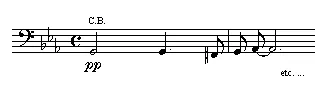
Perhaps something of the desolation Beethoven felt at that moment is expressed in the pianissimo introduction to the symphony (Ex. 1).
Example 1
Beethoven’s coach had already left, and another one had to be summoned from a nearby town. As the hours passed in waiting for the coach, it is reported that Beethoven’s agitation grew ever more strong. Finally the coach arrived, and Beethoven climbed in with a strange, jerky-limbed gait, and they set off along the mountain road. On the way back to Mannheim, at the highest point of the journey, Ludwig stopped the coach, walked to the cliff edge, and without a word cast himself over.
Not yet was he to be allowed the easement of death, however. Fifty feet down his coat was caught in a bush, and Beethoven was left hanging over the abyss. It was several hours before a rescue team arrived from Mannheim, and the attempt to save Beethoven took a great deal of time. He was finally brought to the top fifteen hours after he had fallen, suffering severely from exposure.
In the hospital, he began work on the symphony in earnest. In music he could release the feelings that boiled within him — suffering at which we can only guess. In his hospital bed he planned the symphony — a strangely constructed work of two movements — and chose his text from the published works of Totenfreund. It was only a few weeks before he had completed the draft of the short first movement, which leads without a break into the large-scale choral finale.
The opening of the symphony takes place in an atmosphere of desolation and gloom. The double basses intone their solemn motif, and the violins enter with a hushed tremolando. There is a brief oboe solo which adds to the feeling of timelessness, the falling sixths like stones dropping into the stillness of a stagnant pool.
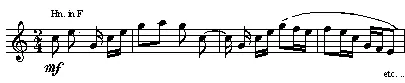
A cymbal clash heralds the beginning of the first subject proper, but first there is a stirring and oddly familiar horn call in an unrelated key, that reminds one of a general marshalling his forces (Ex. 2). Then begins the controversial first subject.
Example 2
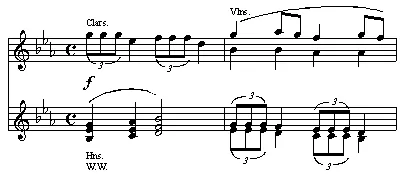
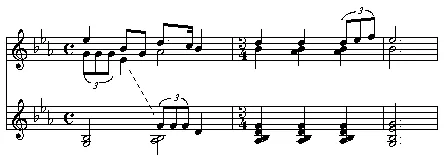
There is no doubt that Beethoven’s unfortunate name had a great effect on him. One can only imagine the effect that this name, the name of the greatest of all masters, would have on the mind of a sensitive composer. Some critics have suggested that Beethoven was influenced by his namesake to an unhealthy degree, and have quoted this symphony, and particularly its first subject, as their evidence. This writer maintains that one has only to listen to the delightful close of this section (Ex. 3) after it has modulated into the E flat major of the forthcoming second subject, to hear the impressive originality of this composer’s mind.
Example 3
The second subject is a great contrast. Perhaps the almost light-hearted nature of the long string tune is due to the fact that at this time Pauline von Birnitz was visiting at the hospital. Certainly this section is the most cheerful thing Beethoven wrote and, at the same time, it demonstrates a remarkably developed melodic gift. There is a fairly short development section, at the end of which the brass blazes forth in a triumphant march, and at its climax the organ enters with a repetition of the double bass motif at the opening of the work.
Then there is silence. The woodwind plays a brief, but hauntingly beautiful chorale (Ex. 4), the bridge from one movement to the next (and perhaps, symbolically, the bridge from one world to the next).
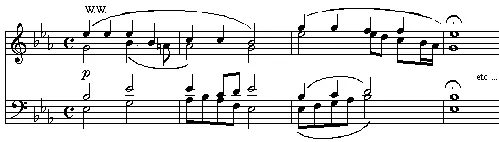
Example 4
It is at this point, at the emotional climax of the work, that Beethoven’s music goes beyond the bounds of purely orchestral sound, and he finds it necessary to introduce the human voice. The symphony moves into a new sphere of experience. The vocal entry is surely one of the most transcendental moments of all music. It is unfortunate that there should be a certain disagreement about which soloist should actually sing this part. Beethoven always showed a distressing carelessness in the preparation of his scores, and his absentmindedness has here caused a great deal of confusion. The part of the Soul is marked in the score to be sung by the contralto soloist. But this part rises at times to b”, and is clearly beyond normal contralto tessitura, as those performances in which the score has been faithfully followed, painfully testify. Usually a soprano is given this difficult part to sing. However, there is a school of thought which maintains that the part should actually be sung by a bass, b” then becoming d (actual pitch). There is some evidence that makes this claim less preposterous. Beethoven, at the time he wrote this symphony, had help from Pauline von Birnitz in preparing the orchestral staves. One can see how easy it might have been for a double mistake to have occurred — for Fraulein von Birnitz to have written “contralto” instead of “bass” and to have then written in the “correct” treble clef; it is also easy to see how Beethoven, in the white heat of his inspiration, could have missed this error.
Having a bass sing this part, and consequently transposing the intervals by major and minor sixths, certainly changes the character of the music. It removes the grinding dissonance of this solo part, which shocks the mind like a bolt of electricity, and expresses the total alienation of the disembodied soul, and reduces the effect to the banal. On this recording the part is taken by a soprano. It is this writer’s opinion that this is the only version that can be taken seriously.
Beethoven followed faithfully the mood of Totenfreund’s text (taken from Canticles and Dramatic Fragments [now out of print]). Certainly the Sixth Symphony has its faults. Some people maintain that the work’s weaknesses outweigh its moments of inspiration: that is for the listener to decide.
Beethoven was to make one more attempt to end his life. On leaving hospital he swiftly arranged a performance of this symphony, the work he believed to be his masterpiece. At great expense he travelled to Vienna, and spent his remaining money on hiring the Konzerthaus for five evenings. Beethoven was sure now that he would find the public acceptance for which he had craved for so long.
The first performance of the Tragic Symphony dashed his hopes to the ground. Beethoven writes: “The hall was unheated, the chorus under-rehearsed, the orchestra hostile, and my great symphony inaudible.”
From contemporary accounts it appears that the performance occasioned a full-scale riot from which Beethoven was lucky to escape with his life. The performances scheduled for the remain four nights were cancelled.
Standing in the rain outside the empty Konzerthaus the next evening, perhaps hearing in his mind the sounds of the closing bars of his symphony and the rapturous applause for which he longed, Beethoven was met by an old colleague from Mannheim. It was then that he learned of the engagement of Pauline von Birnitz to a young rival composer.
That evening Beethoven returned to his lodgings, after walking aimlessly about the streets of Vienna, and drank a great quantity of an oven-cleansing liquid. He was rushed to hospital, and after a long and arduous operation in which half his stomach was removed, he was pronounced saved.
From this time on Beethoven’s life is not at all well chronicled. Beethoven himself stopped writing his journal, and there is a singular lack of contemporary writing about him. We know only that something happened to make Beethoven change his whole attitude to life. Whether he had reached the extremity of suffering, which then metamorphosed into joy, we do not know, but certainly something caused him to change his outlook. Whether this experience was an internal or external one we cannot say. Beethoven himself merely writes, in his last journal entry: “One must live!”
He abruptly began work on the Mass in D, the work that was destined to be his greatest. Hector Berlioz was present at the first performance, and wrote in his Memoires:
Ludwig van Beethoven II has never been taken seriously as a composer, and deservedly, for there is no doubt that his work has had grievous faults, not the least of which has been its singular lack of inspiration. I say to you now, having heard last night his Mass in D, that his muse has at last responded, nay, has veritably heaped upon his head the riches of a lifetime! With what fluttering intoxication I experienced Beethoven’s music last night! I tore out my hair in a delirium of delight, I wept, I could not restrain the groans that Beethoven drew from me! Beethoven says to us: “You must live life to the full; you must take the suffering and build it into a foundation for joy, for joy is eternal, and can never die.” Here is life herself speaking to us with her full and glorious voice. I say that Beethoven’s Mass is one of the greatest of all musical works, and had I written but one bar of this work, then I would have accounted my life worthwhile.
In view of this, it is nothing less than a tragedy that this one performance of the Mass seems to be the only one every to have taken place. The manuscript appears to have been lost, and has since never come to light.
Immediately after completing the Mass, Beethoven sustained a small wound to the right thigh, after falling in the street outside his house. Blood poisoning soon developed, and within three weeks he had died. An ornate tomb was constructed at Mannheim, but it was unfortunately destroyed during the war.
The Text
SOUL: I slept awhile, and now I am awake,
I see that all that went before was but a dream.
All is still, and now I understand
This stillness is the nat’ral state of things,
And that the flurry of my earthbound life
Was but the struggle of a soul in flight,
In fear of drinking at the fountainhead.
Into my being is poured a magic wine
Of stillness; now I know
There’s no escape from this, my judgement way.
The wine has made me like a ship
At rest from tossing on a busy sea.
Now I can lift my anchor up and fly
On snowy wings into the glory of the day.
CHORUS OF MOURNERS: Lord, have mercy on him,
Christ, have mercy on him.
SOUL: And down below my friends I see
Clustered about my bed,
Knowing not that I, a bird, do fly
The airy vaults of time,
My sails outspread, my dipping prow,
The wine of peace from stern to bow.
But what is this? I feel that I
Am urged still further in the sky.
Did not this solitude so lack
Another being apart from me,
And had I now corporeal form,
I’d say a hand pressed in my back.
ANGEL OF THE LOWER REGIONS: Be thou not feared, O little soul,
‘Tis only I, thy humble guide
Into the regions of the bless’d
Where thou shalt stand before the throne
And see thy Father, there to take thy place
On the heavenly scale, and to be judged and weighed.
SOUL: O blessed one, my gratitude will surely
Kiss thy face with flutt’ring wings!
But there is something I would say
Had I the courage now to speak.
ANGEL: Speak now, my son, for there is nothing here
To cause you to forbear.
SOUL: Then I will speak; O glorious being,
I would not try to influence my fate,
For I would see the Holy One,
But in my earthly life I stood
On many scales, and I do know my weight.
ANGEL: O innocent! O cow’ring soul!
These scales are nothing like the ones you know,
But measure here the worthiness,
The virtue and the grace of he who’s weighed.
The denizens of heav’n oft speak rhetorically,
These scales are just meant metaphorically.
SOUL: Now all is clear, as if the world
Were bathed in incandescent light!
My understanding shines forth like a flare,
Lighting up this everlasting night!
Were I so bold, and not so wise,
I’d say that scales had fallen from my eyes.
CHOIR OF PENITENTS: Be gracious in thy mercy, Lord,
This soul that upward flies towards thy face
Is black with sin, but can be purified
By thy stern judgement, thus transposing it
Into the purest white of holy grace!
Praise thee, O Lord, in thy power and glory
Praise thee, O Lord, in thy fullness of eternity
Praise thee, O Lord, in the majesty of thy coming
Praise thee, O Lord, thou highest of the high!
SOUL: And now my angel has departed,
Leaving me alone to swim
In the seas of space and time,
When I was getting used to him.
But now a shudd’ring anguish fills me through,
Although I travel on at faster pace.
I shiver, and my being is full of doubt
That I shall see my Holy Master’s face.
ANGEL OF THE UPPER REGIONS: Thou should not fear, O quaking soul,
Thy pain is nought but agony
Of incompleteness: thou shalt see his face,
For my task is to conduct you to his gracious being.
But the seeing of him you will find overpowering,
And thy present pain will multiply itself,
But our most glorious Church has always taught
Its worshippers to glory in their anguish,
And many times has added to their pain
By taking their last money for our altars
So that they starve, in preparation for the afterlife.
And when thy pain comes shalt thou too rejoice
To see the greatness of the greatest one,
To see His face, to hear His voice.
SOUL: All hail, O being of the higher slopes!
Your message brings to me great comfortment.
But I grow now impatient for my moment to begin.
ANGEL: Your patience is no longer needed, soul,
For we are in the highest air of all,
Where all is rarified and pure.
These are the highest bounds of heav’n,
Where lives the highest one of all.
SOUL: And now I feel myself drawn up
As if by a power beyond my comprehension.
A strange convulsion grips my senses,
A delirium of glory!
I feel that I have come at last
Unto the place where I will meet my Lord.
For this moment was I first created,
And spent my earthly life so long ago.
A golden shape before my eyes I see,
And I know now that I’m approaching Thee!
CHOIR OF ANGELICALS: Praise to the God of ages past,
Praise to the Lord today,
Who made both heav’n and earth and hell,
To help in ev’ry way.
Who sent his only son to us
To labour and to toil,
To spend his life in earthly pain
Old Satan’s plans to foil.
Who rules above in glorious might,
With Christ at his right hand,
And spreads his waves of gorgeous pain
All over this fair land.
ANGEL: Brothers! Hist! The soul I see
Descends from the high throne
In pain and wrapp’d in misery,
The judgement now is done.
SOUL: Stand back, O Angels, touch not me,
My pain I cannot tell,
For down I go with utmost speed,
To the very depths of Hell.
ANGEL: Brothers, be not thou downcast,
At this soul’s plight thou must not frown,
For though this damned soul plunges fast,
At least we cannot be cast down.
ANGEL OF THE UPPER REGIONS & CHOIR OF ANGELICALS:
Praise to the God of ages past,
Praise to the Lord today, etc…
Copyright © 2001 by Langdon Jones.